
It would be a good idea for a discipline like networking to become a habit right from the start of our studies. Whether we’re doing vocational training or a university degree, starting to build our network before entering the job market will be a great help to us.
I have yet to see networking as a subject in the syllabus of any master’s programme. It’s a marketing tool for knowing how to approach new clients, it’s a communication tool for making yourself and your company known, but above all it’s a personal skill for projecting your professional image, earning the trust of your contacts and maintaining a long-term relationship.
That’s why what I do recommend is that, right from the start, you make the most of some of the sources for networking during your studies, whether it’s a degree, a higher education course, a specialisation…:
- Get on well with your classmates; perhaps you’ll start a project with one of them in the future
- Get on well with your teachers. In my case they helped me with my project; others will hire you or get you your first job
- Get on well with the school staff. They might also take you on as a collaborator, teacher, salesperson…
- Join the alumni association. It will help you stay in touch with former classmates and attend new courses and events
- Even drop by your old school from time to time to say hello to the people you met; keep the bond alive
- If you get the chance to extend your studies through an international agreement, take the opportunity to study abroad
Following on from that last point, the subject that will be most useful to you, whatever you study, is ENGLISH. In my case I started learning it at the age of 8, and I’ve never stopped studying and practising it.
English has been one of the subjects that has opened the most doors for me professionally, and it has helped me grow within multinationals such as Xerox, Regus and Xing. Don’t hesitate: really get stuck into ENGLISH, and even better if you go abroad to learn it.
Here, ERASMUS programmes are the best way for you to leave the nest and live in and learn a foreign language, mainly ENGLISH, but why not French, German, Italian too…
Thanks to the Recruiting Erasmus event led by People Matters, headed by its managing partner Alfonso Jiménez, I was able to learn more about how this programme works.
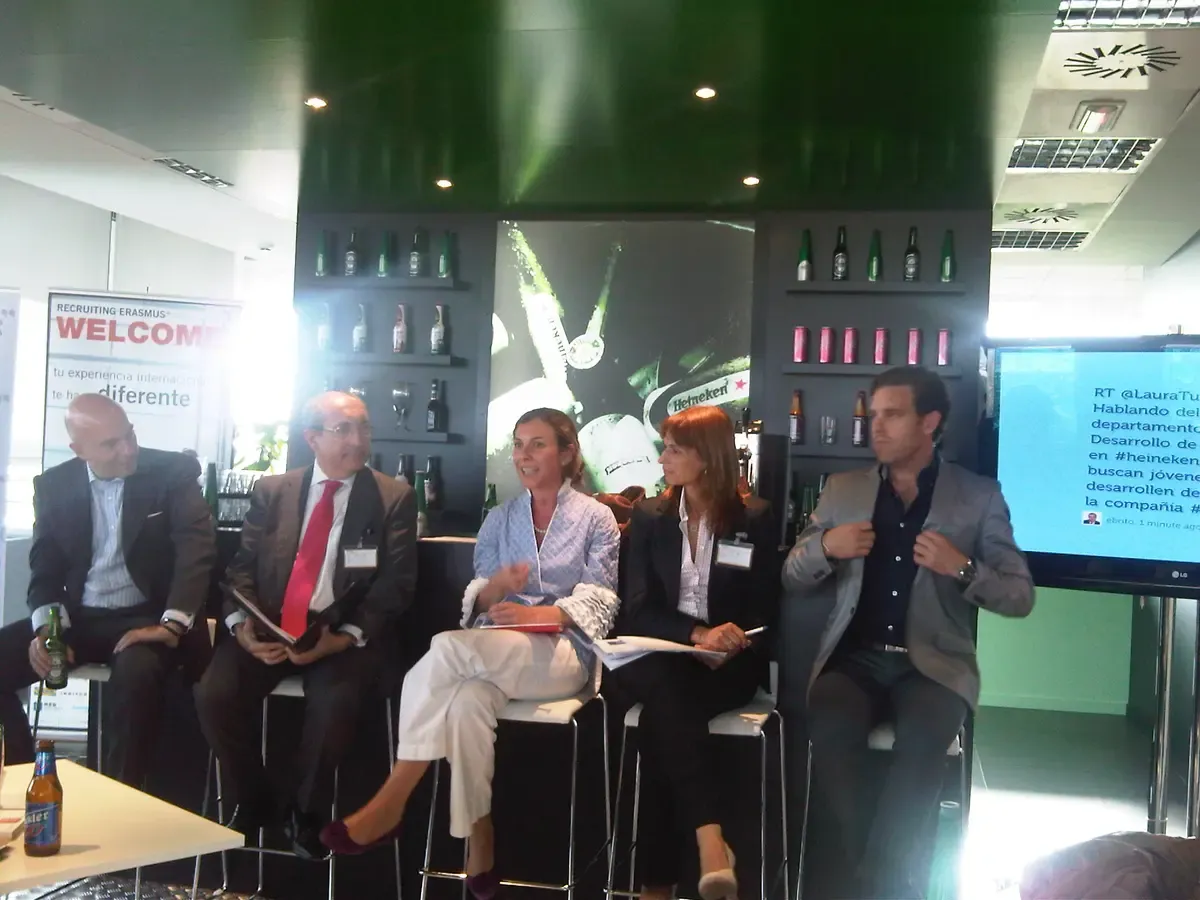
The agency Tuatu Social Media was in charge of inviting a number of bloggers who write about employment, as well as some of the companies taking part in the Recruiting Erasmus programme, such as BBVA, Indra and Vodafone.
The company that hosted us at its headquarters was Heineken, so that afternoon we “thought green” and got to hear three perspectives: the university’s, the companies’, and that of former ERASMUS students who are now executives at some of the leading companies in our country taking part in the programme.
The big advantage nowadays, once you’ve been on ERASMUS, is how easy it is to stay connected with the people you met abroad. At first it was only email, then Messenger or Skype, and finally social networks arrived.
Social networks are proving to be a perfect communication channel for getting back or staying in touch with former classmates, with specific networks and hundreds of groups on Facebook.
People Matters, for its part, has made the most of its social media presence to promote the Recruiting Erasmus programme; in my view the YouTube channel, where the participants tell their experience first-hand, is a real success. Take a look here.
Here are a few links that I hope will help you find out a little more about the subject.
Follow Recruiting Erasmus on Twitter: http://twitter.com/#!/re_11
http://www.facebook.com/RecruitingErasmus?sk=notes
http://www.oapee.es/oapee/inicio/pap/erasmus.html
http://es.wikipedia.org/wiki/Programa_Erasmus
http://www.erasmusworld.com/portal/index.php?sel_lang=spanish
So now you know: main subject ENGLISH, second subject NETWORKING!!
Categories